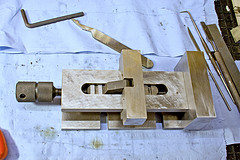
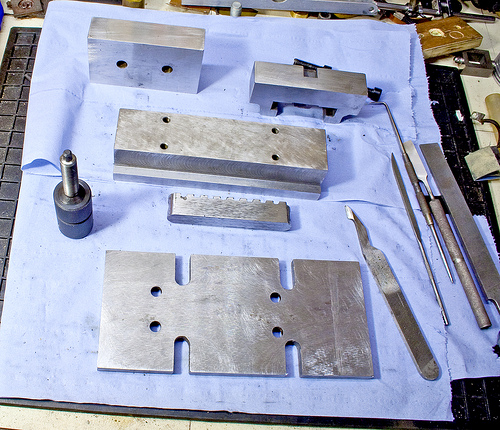
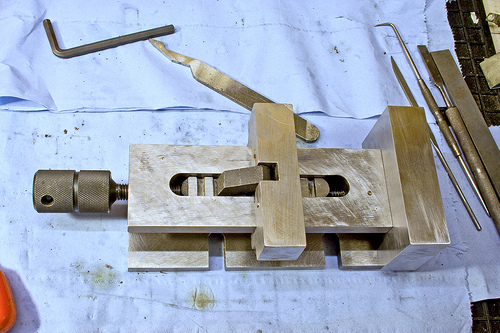
A few nice brass China turned parts images I found:
Where there’s Muck, there’s Brass Setup
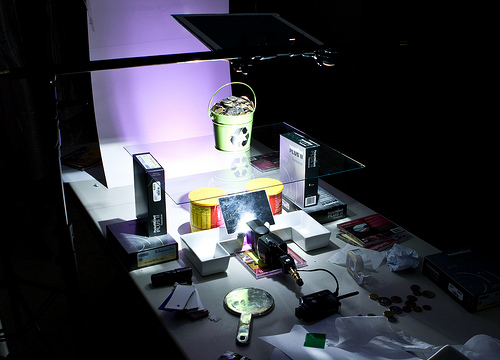
Image by nickwheeleroz
Strobist Information:
I had been thinking about this assignment for a few days and had not come up with any real workable ideas when I was fetching something from the garage and spotted the green tin in the picture. It was originally a novelty plant pot and as soon as I saw it the idea for the picture popped into my head. If the light had to do double duty, then why not the topic?
The first problem I had was how to get the recycle symbol onto the tin. This turned out to be the hardest part of the whole project and ended up taking me two days! My first idea was to create a template and draw it on with a magic marker. I downloaded the recycle symbol from the internet and printed it out to the size I wanted. I then taped the paper to a sheet of sticky back plastic (the sort school children use to cover there exercise books) and then taped this to a sheet of cardboard. I carefully cut out the shape with a box cutter and popped out the individual pieces. I was left with a nice neat template that I could stick directly to the tin. With this in place, I filled in the holes with the magic marker and left it a couple of minutes to dry. Feeling pretty pleased with myself for coming up with such an ingenious solution I carefully peeled off the plastic to revel a complete mess! The magic marker had seeped under the plastic and left an unusable feathery mess on the tin. Oh dear, not quite what I had planned. Luckily, I still had the other side of the tin I could use, but I would have no more second chances, what ever I tried next would have to work.
I still had the template and wondered if I could draw the symbol by hand. I traced the outline using a pencil and was just about to start drawing when I thought better of it and decided to have a practice on the ruined side. Good job I did, as my attempts to draw the symbol by hand were a little disastrous to say the least. Time for another idea.
I thought about the problem for a while and then remembered I had some iron on t-shirt transfer inkjet paper. I wondered if this might work on the tin. I printed the symbol (reversed) onto a sheet of the special paper and fired up the iron. Again, I decided to try things out on the by now rather shabby looking side of the tin and again it was a good job I did. The transfers work great on cotton, on tin, not so well. The resultant sticky mess was not at all pleasing to the eye.
I was starting to run out of ideas, but then decided to try printing directly onto the sticky back plastic. I cut a sheet out to A4 size and feed it into the printer. Within seconds it was plainly obvious that this was a stupid idea as big globs of ink ran down the plastic all over my desk, my hands, my carpet and anything else within ten feet of the printer. I gave up and went to bed.
The next day I went to the local K-mart to see if I could find some sort of transfer paper that would work on the tin. No luck, but what I did find was a roll of black shiny sticky back plastic. Perfect! I took a roll home and created another template, this time keeping the parts I cut out and discarding the outline. I then stuck the individual pieces to the tin and what do you know, one very passable recycle symbol.
With the props sorted out it was time to put the picture together. First I filled the tin with crumpled up paper and then raided the piggy bank for every coin we had. I piled these up on top of the paper to make it look like the tin was full to overflowing.
Next I started building the set up. I knew I wanted the light to light the front of the tin, the coins on top and the background. The first thing to do was to raise the tin off the ground. I used my PW boxes to support a sheet of glass from a picture frame and put the tin on top of this. There was now enough room underneath it to start splitting up the light from the SB-28.
I placed the flash on its side just slightly in front of the tin pointing towards the background. I then put a small mirror at a 45 degree angle right up against the flash so that it split the flash head in half. I taped a purple gel to the bottom of the mirror so that it hung in front of the bottom half of the flash. This would be the light for the background.
The 45 degree mirror fired light upwards across the front of the tin but left the money in the top in the dark. To get some light on this, I clamped a mirror tile into a reflector holder and placed it above the tin just in front of it and angled back towards it slightly. I worked out the exact placement to get maximum light by replacing the flash with a small LED torch. I could see from this exactly where the light was going to fall.
The last step was to place the background. I used a large sheet of white card and hung it from a wooden rod clamped into a super clamp on a light stand. I hung the card so that the bottom rested on the table and allowed me to bend it slightly to give a nice graduation to the background colour.
With everything roughly in place I started taking pictures and made a few slight adjustments to tweak the lighting. I initially had the flash on full power thinking that splitting the light would cause it to loose a lot of power, but it was pretty obvious that half power was plenty for this shot.
The final setup ended up looking like an experiment in a particle physics lab and having two more SB-28’s in my camera bag next to me made all the adjustments to get the background, foreground and top lighting right seem like a lot of work, but it was very satisfying when the final shot came together!
Picture here: Where there’s Muck, there’s Brass
Learn how to light: www.strobist.com
Steampunk Beholder Miniature robot sculpture – Daniel Proulx – Canada . : Steampunk Exhibition at The Museum of the History of Science, The University of Oxford, U.K.
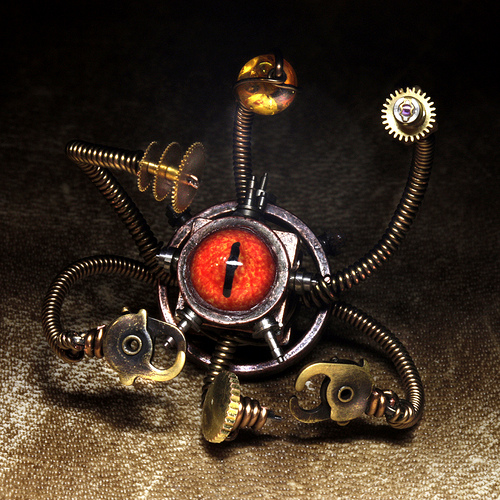
Image by Catherinette Rings Steampunk
The sculpture is only 4 cm large .
right upper arm : You can imagine that arm shooting a disintegrating
Newtonian beam .
Left upper Arm : Triple saw made from vintage brass clock gear .
Top Arm : Made from Mysterious yellow amber .
bottom arm : a single magnetic wheel for an alternative transport and stability .
Beholder’s floats/hover above the ground . They are known to be obsessively Tyrannic .
Made by Daniel Proulx A.K.A : CatherinetteRings , Steampunk jewelry designer and sculptor
This sculpture is currently on display for the Oxford Steampunk Exhibition .
BEHOLDER WRITTING COMPETITION STORIES :
1ST PLACE WINNER:
A Light in the Darkness
by Will Steed
Hastings looked down the tunnel into the darkness. He looked down at his feet. The pools of filth lay stagnant on the ground at the edges, while a stream of foulness trickled down the middle. His shoes would have make do on their own. Some yards further into the tunnel, he found a twisted piece of iron left off to the side. He knew he was in the right place. The maker’s mark on the iron matched the ones taken from the smith’s yard near the docks.
Still further down the tunnel, there was a branch. One would lead to the lower reaches, the other further south, towards the houses on Merchant’s Row. The criminal element of the lower reaches were prime candidates for the theft of scrap iron, but something tickled at the back of Hastings’ brain. His intuition told him there was a connection between the theft of the scrap iron and rumors of an alliance between technologists and the guild of merchants, but there was nothing to prove it, or even to suggest that it was more than the hunch of a detective on probation.
Hastings listened carefully. Over the rumble of the train passing above, he could hear a deep rhythmic sound coming from the tunnel that lead towards Merchant’s Row. He walked cautiously down the tunnel, avoiding the splashing of walking in puddles of Ada-knew-what.
As he progressed, the rhythm grew louder and resolved itself to human voices, chanting, and the flicker of torches bounced off the wall. A cult? he thought to himself. That would be the third one this year. He reached into his coat pocket and pulled out a metal flask, holding it firmly in his hand. As he approached the source of the chanting and flickering, he unlatched a metal cylinder from the beltloop that held his coat.
Before he made his presence known, he stopped to listen. The chanting was in Latin – Laudamus te, deo omnifacente, adjuta nobis, dea technologistorum. Of course it was in Latin, he thought. Latin is the language of the Roman church, why not of other gods? This cult originator had apparently done his research on cultistry. The chanters had dark robes, chalk designs on the floor, and a brass altar. Upon the altar, the mystic theme was broken by a pile of scrap metal. Among the lead and iron piping lay a large vicegrip, a dangerously oversized blunderbuss and a rotary sawblade.
Hastings drew attention to himself by flicking the lever on the side of the metal cylinder. The snapping of a spring and the sliding of metal against metal drew the attention of two cultists, who broke from the circle of robed enchanters and advanced on him. With his truncheon extended, he let the robed chanters reach him. The chanting from the other cultists changed, growing louder as he faced the fighters: venite, surmitte nobis monstrum mechanicum. The swinging truncheon caught one cultist on the knee, his scream loud enough to be heard over the chant, which grew louder with each repetition. A blow from the second cultist knocked him to the floor, his truncheon rolling out of reach, lying halfway into the chalk circle on the floor.
The lead cultist, with a thick gold chain hanging around his neck, drew forth a glass orb and placed it on the altar as the chanting stopped, leaving a ringing in Hastings’ ears, and only the screaming of the injured cultist rang through the tunnel. The cultist who had punched Hastings pulled him up by his coat-front. Hastings shook the flask in his left hand and flicked the lid off it. A smell even fouler than the stench of the effluent in the tunnels rose into the cultist’s nose. The grip on his coat slackened as the cultist collapsed to the floor in a stupor.
Covering the flask once more, Hastings returned his focus to the other cultists. The torches had blown out while his attention was distracted, and the tunnel was lit by the golden glow of the orb on the altar. The light was growing fast, and Hastings and the cultists were forced to cover their eyes.
When the light cleared the pile of scrap on the altar had gone. Instead, a metal creature was suspended in mid air above the altar. A large eye in the middle surveyed the room suspiciously while metallic tentacles moved around it. The sight of metal moving like flesh made Hastings’ own flesh crawl. Most of the cultists looked as shocked and sickened as Hastings, backing away towards the walls, but the lead cultist held his ground.
‘Behold! I bring you forth from the divine workshop’ he declaimed. ‘I bind you to this place, leaving only to do my bidding! I hold you here under my power until I see fit to remove you to the place from which you came.’
The metal creature regarded the room carefully, floating in silence. Its eye turned to the chalk markings on the floor. It floated to the edge of the circle, where Hastings’ truncheon lay across the line on the floor. The eye shifted its gaze back to face the lead cultist, whose eyes had grown wide. The cultist looked at Hastings.
‘What have you done?’ he demanded of Hastings. ‘You’ve given it its freedom. We have no control over it.’
Hastings knelt on the floor, looking dumbly at the metallic creature, which beheld the scene before it. The creature floated out of the chalk circle, leaving directly over the gap made by the truncheon. The eye beheld Hastings once more, dipping softly, before floating back up the tunnel towards the surface of the city.
The lead cultist fled after it, declaming in Latin. After they had both gone out of sight, there was the scream of spinning metal, the scream of suffering man and the sickening sound of death. A golden light flashed, and the screaming stopped.
Now in the dark, Hastings drew out a small box with a crank on it. After a short winding, a light glowed in the darkness. The whimpering sound of the remaining cultists turned to gratitude, and Hastings led the cultist merchants slowly back to the surface.
In a foggy alleyway, a light yellow glow grew. A scream pierced the night, and then there was silence.