Latest China Prototypes News

Finding Indicators of Life From Space—NASA Rescues Few in Nepal
Soon after days of getting pinned beneath up to 10 feet of rubble, four guys were rescued in Nepal thanks to NASA search-and-rescue technologies. The device utilized in the rescue is referred to as Discovering Individuals for Disaster and Emergency Response, or FINDER, and&nbsp…
Study much more on Science Times

Surface design lead compares early Surface prototype to a 1974 Volkswagen
Nonetheless, the investment in magnesium was massive, and the initial developed pieces have been hideous. Groene flew to China every single other month to master the inject modeling of magnesium approach. The process was so in depth that Microsoft ended up with IP on&nbsp…
Study a lot more on WinBeta

Tesla beats Wall Street forecasts on record quarterly sales
Palo Alto, California-based Tesla said North American and European orders for the Model S sedan have been up, but orders in China continued to lag expectations. Tesla stated it remains confident it will sell 55,000 Model S sedans and Model X SUVs this …
Study a lot more on Arizona Daily Star

Hemisphere GNSS Releases New Innovative, Planet-Class GNSS RTK Engine

SCOTTSDALE, AZ (PRWEB) May 07, 2015

Hemisphere GNSS announces the release of Athena, their subsequent generation GNSS engine. Supplying significantly enhanced functionality, often exceeding that delivered by other business leaders, Athena offers Hemisphere with a future-proof foundation enabling industry-defining performance, flexibility, and reliability.

&#13

Hemisphere has created its new core engine to maximize the company’s potential to excel at the rigorous GNSS requirements of multiple market place segment consumers in Machine Handle, Survey and GIS. Athena’s innovative design tends to make it a state of the art GNSS technology for now and in the future.

&#13

The release of Athena is a important milestone for Hemisphere but just the 1st piece of a wave of new technologies getting delivered into the market place by Hemisphere in 2015.

&#13

“Our goal is to be absolutely nothing short of the greatest GNSS technologies partner in the business, and a key component of that is delivering industry-top technologies tailored to our customer’s demands,” declared Chuck Joseph, Hemisphere GNSS CEO &amp President. “To that finish we have place with each other a planet-class group that is completely rethinking our product loved ones, and our new Athena engine is just the 1st, potent proof of our fresh strategy. Watch this space!”

&#13

Outstanding Capabilities

&#13

Athena excels in practically every atmosphere where higher-accuracy GNSS receivers can be utilized. Hemisphere’s consumers have tested and confirmed Athena’s overall performance in long baseline, in open-sky environments, beneath heavy canopy, and in geographic places experiencing important scintillation.&#13

Initialization time – One of the most reliably constant initialization performances in the sector, whilst at the exact same time, performing initializations in significantly less than 15 seconds at much better than 99.9% reliability&#13
Robustness in extremely tough operating environments – Incredibly high productivity under the most aggressive of geographic and landscape oriented environments for GNSS, even though delivering up to 50% much better efficiency in user tests matched against the ideal competitive systems on the industry&#13
Overall performance on lengthy baselines – Industry-major position stability for long baseline applications, with position high quality frequently instances exceeding the performance of the best-of-breed RTK systems on the market&#13
Functionality under scintillation – Sustained accuracy under ionospheric scintillation activities, providing 1 of the most reputable approaches in the marketplace to work with GNSS in scintillation-impacted places

“I’ve had an opportunity to thoroughly test Athena in both moderate and extreme environments,” stated Andy Carbognin, Independent GNSS Test Specialist at Vecto Geomatics. “I’m extremely impressed with the performance, and we’ve tested alongside the existing business leaders’ leading-of-the-line goods. In each and every situation, Athena is proving to be a tremendous improvement over Hemisphere’s most widespread legacy firmware versions, at a minimum, matching the industry’s very best while in a lot of situations exceeding their overall performance.”

&#13

Market Help

&#13

“Carlson Application has extensively tested Hemisphere’s new Athena RTK engine on the Carlson BRx5 GNSS receiver. The Athena RTK engine supplies precise, trustworthy, and repeatable positions. Athena exceeds or matches the functionality of all other GNSS receivers it has been tested against. We have been specifically impressed with the overall performance of the Athena engine, when making use of a lengthy baseline or in places exactly where there is a limited view of the sky. Athena is a first class RTK engine,” expressed Butch Herter, Director of Hardware Improvement, Carlson Application.

&#13

“In the marine building and hydrographic survey markets, time is cash. We’ve observed quite higher technique reliability and impeccable results employing the Athena RTK engine, which guarantees we are reaching maximum up-time,” stated Harrison Steves, Operations Manager at Cable Arm. “As effectively, not getting tied to a specific make of RTK base offers us flexibility with our gear deployment.”

&#13

“We’ve identified Athena to supply exceptional overall performance, particularly their RTK fix occasions and sustaining RTK lock on lengthy baselines,” said David Vaughn, CEO, Novariant. “With the newest competitive performance testing completed, Novariant is excited about adding Hemisphere’s Athena supplying to the list of the Novariant-recognized certified receivers that, when combined with our precision steering resolution, can assure centimeter-level steering control in the toughest environments in the globe.”

&#13

“We’ve been functioning with Hemisphere’s technologies for a quantity of years,” states Randy Noland, VP of Business Development and Director of Machine Handle, Carlson Software program, Inc. “I’m amazed at the team they’ve brought with each other and how they’re radically modernizing their technologies. Collaborating with the ‘new’ Hemisphere has been an eye-opening expertise, and I’m excited at how their revolutionary technologies will positively effect our future business”.

&#13

Availability

&#13

Just before the end of this month, Athena will be incorporated in all Hemisphere multi-frequency, RTK-capable items, such as the A325, R330, S320, and VS330. To download and set up Athena, check out Hemisphere’s Application web page: http://hemispheregnss.com/Sources/Software

&#13

About Hemisphere GNSS, Inc.&#13

Hemisphere GNSS styles and manufactures revolutionary, cost-effective GNSS items for positioning, heading, and navigation applications for marine, survey, building, mapping, OEM, and other markets. The Business holds numerous patents and other intellectual house and sells globally with many major solution brands, which includes Crescent®, Eclipse™, and Vector™ for precise GNSS applications. Hemisphere GNSS has its business headquarters in Scottsdale, Arizona, USA with a solution improvement, sales, and advertising facility in Calgary, Alberta, Canada. Hemisphere GNSS is portion of UniStrong Science &amp Technology Co., Beijing, China. For far more details about Hemisphere GNSS, please go to http://www.HGNSS.com.

&#13

For much more info, please contact:&#13

Lauren Romancho&#13

Hemisphere GNSS&#13

Telephone: +1 (480) 348-6380&#13

E-mail: lromancho(at)hgnss(dot)com

&#13
&#13
&#13
&#13
&#13

Related Precision Engineering Businesses Press Releases

Buckle up and Race to Indy with the Most Well-known Toy Cars on the Planet – Hot Wheels(TM): Race to Win(TM)

Buckle up and Race to Indy with the Most Well-known Toy Cars on the Planet – Hot Wheels(TM): Race to Win(TM)


Indianapolis, IN (PRWEB) May 07, 2015

All roads lead to Indianapolis as the world’s biggest children’s museum opens Hot WheelsTM:Race to Win™ just in time for the Indy 500. This new loved ones exhibit will get you revved up with immersive racing activities for three generations of Hot Wheels® fans. There’s one thing for mom, dad, grandparents and of course today’s youngest Hot Wheels fans. Hot Wheels: Race to Win debuts May 9, 2015, at The Children’s Museum of Indianapolis and will tour throughout the country over the next five years.

&#13

Be component of a dynamic race group functioning collectively to create and test the fastest (and safest) speed machines on the planet, using Hot Wheels die-cast vehicles to experiment and play. This behind-the-scenes appear at the thrilling world of racing investigates the scientific method for designing super-quick automobiles and helps households who have the need for speed realize how it is accomplished.

&#13

“There’s no better spot than the racing capital of the world (Indianapolis) to show families how speed, power and design and style are used to make cars go quicker. This family finding out knowledge will supply hands-on possibilities for parents to clarify complex physics concepts in entertaining techniques using the well-liked Hot Wheels toy cars as they experiment with diverse principles to see which makes a automobile or truck go fastest,” stated Dr. Jeffrey H. Patchen, president and CEO, The Children’s Museum of Indianapolis.

&#13

“The Children’s Museum of Indianapolis, situated in the center of every little thing racing, is the perfect companion to launch the new Hot Wheels: Race to Win traveling exhibit. Generations of young children have enjoyed the thrill and speed of racing with Hot Wheels, and this new interactive exhibit now brings households collectively to learn what brings racing to life in a entertaining and memorable way,” said Julie Freeland, Senior Director, International Live Events &amp Attractions, Mattel.

&#13

Children and Families will love the Pit Quit Challenge in which they can race the clock – and their household and close friends – to alter tires and refuel the automobile. A downhill track, looping jump track, precision track, and crash track are just a few of the approaches visitors will be able to test their theories regarding the science of racing and lead to and effect. True race car parts, authentic artifacts, and captivating memorabilia will round out the experience.

&#13

Introduced by Mattel in 1968, the “tricked-out” toy automobiles have come a extended way (both in the die-cast and life-size varieties). Far more than 800 models and 11,000 variations of Hot Wheels automobiles have been developed and more than 4 billion Hot Wheels die-cast vehicles have been sold.

&#13

Don’t miss the chance to push the limits of your imagination and find out about the globe of racing in this all-new exhibit. Hot Wheels: Race to Win™ is presented by Teachers Credit Union. Supporting sponsors are Church Brothers Collision Repair and 1 America. The exhibit was developed by The Children’s Museum of Indianapolis and Mattel, Inc.

&#13

Right here are some other planned stops on the exhibit’s tour (topic to modify):&#13

Fall 2015 Discovery Science Center in Santa Ana, California. Spring 2016 at the Strong Museum Rochester, NY Summer time 2016 at The Children’s Museum of Indianapolis Fall 2016 at Discovery Centre in Halifax, NS. Spring 2017 Reading Public Museum, Reading, Pennsylvania Summer season 2017 The Children’s Museum of Indianapolis Fall 2017 at the Omaha Children’s Museum in Omaha, NE. Spring 2018 at Science Planet in Vancouver, BC Summer time 2018 at The Children’s Museum of Indianapolis Fall 2018 at COSI in Columbus, Ohio. Spring 2019 at the Minnesota Children’s Museum in St. Paul, Minnesota Summer time 2019 at The Children’s Museum of Indianapolis Fall 2019 at the Orlando Science Center in Orlando, FL. Spring 2020 at Discovery Science Center in Los Angeles, California, and Summer season 2020 at The Children’s Museum of Indianapolis, with other areas to be announced.

&#13

About The Children’s Museum:&#13

The Children’s Museum of Indianapolis is a nonprofit institution committed to generating extraordinary household studying experiences across the arts, sciences and humanities that have the power to transform the lives of youngsters and families. For much more information about the tourist attraction and museum, pay a visit to http://www.childrensmuseum.org, follow us on Twitter @TCMIndy, Facebook.com/childrensmuseum and YouTube.com/IndyTCM.

&#13

About Mattel:&#13

The Mattel loved ones of firms is the worldwide leader in the design, manufacture and advertising and marketing of toys and family items. Mattel’s portfolio of best-promoting brands includes Barbie®, the most well-liked style doll ever produced, Hot Wheels®, Monster High®, American Girl®, Thomas &amp Friends® and Fisher-Price® brands, such as Little People® and Power Wheels®, MEGA® Brands, including MEGA BLOKS®and RoseArt®, as properly as a wide array of entertainment-inspired toy lines. In 2013, Mattel was named 1 of the “World’s Most Ethical Companies” by Ethisphere Magazine and in 2014 ranked No. 5 on Corporate Duty Magazine’s “100 Greatest Corporate Citizens” list. With worldwide headquarters in El Segundo, Calif., Mattel’s firms employ almost 30,000 folks in 40 nations and territories and sell goods in more than 150 nations. At Mattel, we are making the Future of Play. Pay a visit to us at http://www.mattel.com, http://www.facebook.com/mattel or http://www.twitter.com/mattel

&#13
&#13
&#13
&#13
&#13

Much more Precision Engineering Organization Press Releases

Cool Prototype Makers In China pictures

Cool Prototype Makers In China pictures

A handful of nice prototype manufacturers in china pictures I located:

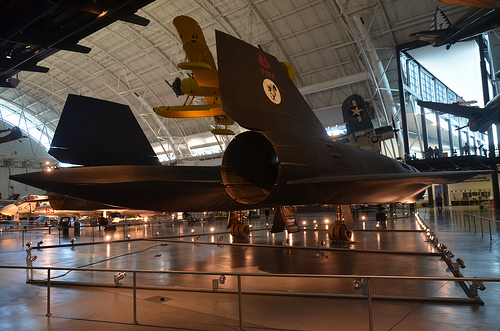
Steven F. Udvar-Hazy Center: SR-71 Blackbird (starboard tail view)

Image by Chris Devers
See much more photographs of this, and the Wikipedia post.

Specifics, quoting from Smithsonian National Air and Space Museum | Lockheed SR-71 Blackbird:

No reconnaissance aircraft in history has operated globally in much more hostile airspace or with such full impunity than the SR-71, the world’s quickest jet-propelled aircraft. The Blackbird’s overall performance and operational achievements placed it at the pinnacle of aviation technology developments for the duration of the Cold War.

This Blackbird accrued about two,800 hours of flight time throughout 24 years of active service with the U.S. Air Force. On its final flight, March 6, 1990, Lt. Col. Ed Yielding and Lt. Col. Joseph Vida set a speed record by flying from Los Angeles to Washington, D.C., in 1 hour, four minutes, and 20 seconds, averaging 3,418 kilometers (2,124 miles) per hour. At the flight’s conclusion, they landed at Washington-Dulles International Airport and turned the airplane more than to the Smithsonian.

Transferred from the United States Air Force.

Manufacturer:
Lockheed Aircraft Corporation

Designer:
Clarence L. &quotKelly&quot Johnson

Date:
1964

Country of Origin:
United States of America

Dimensions:
General: 18ft 5 15/16in. x 55ft 7in. x 107ft 5in., 169998.5lb. (5.638m x 16.942m x 32.741m, 77110.8kg)
Other: 18ft 5 15/16in. x 107ft 5in. x 55ft 7in. (five.638m x 32.741m x 16.942m)

Materials:
Titanium

Physical Description:
Twin-engine, two-seat, supersonic strategic reconnaissance aircraft airframe constructed largley of titanium and its alloys vertical tail fins are constructed of a composite (laminated plastic-kind material) to lessen radar cross-section Pratt and Whitney J58 (JT11D-20B) turbojet engines function massive inlet shock cones.

Good Prototype Manufacturers In China photos

Good Prototype Manufacturers In China photos

Verify out these prototype producers in china photos:

Steven F. Udvar-Hazy Center: South hangar panorama, like Vought OS2U-three Kingfisher seaplane, B-29 Enola Gay, among other people

Image by Chris Devers
Quoting Smithsonian National Air and Space Museum | Vought OS2U-3 Kingfisher:

The Kingfisher was the U.S. Navy’s principal ship-primarily based, scout and observation aircraft during Globe War II. Revolutionary spot welding methods gave it a smooth, non-buckling fuselage structure. Deflector plate flaps that hung from the wing’s trailing edge and spoiler-augmented ailerons functioned like further flaps to enable slower landing speeds. Most OS2Us operated in the Pacific, where they rescued a lot of downed airmen, like World War I ace Eddie Rickenbacker and the crew of his B-17 Flying Fortress.

In March 1942, this airplane was assigned to the battleship USS Indiana. It later underwent a six-month overhaul in California, returned to Pearl Harbor, and rejoined the Indiana in March 1944. Lt. j.g. Rollin M. Batten Jr. was awarded the Navy Cross for creating a daring rescue in this airplane below heavy enemy fire on July four, 1944.

Transferred from the United States Navy.

Manufacturer:
Vought-Sikorsky Aircraft Division

Date:
1937

Country of Origin:
United States of America

Dimensions:
Overall: 15ft 1 1/8in. x 33ft 9 1/2in., 4122.6lb., 36ft 1 1/16in. (460 x 1030cm, 1870kg, 1100cm)

Materials:
Wings covered with fabric aft of the main spar

Physical Description:
Two-seat monoplane, deflector plate flaps hung from the trailing edge of the wing, ailerons drooped at low airspeeds to function like further flaps, spoilers.

Steven F. Udvar-Hazy Center: P-40 Warhawk with “sharktooth” nose

Image by Chris Devers
See a lot more pictures of this, and the Wikipedia article.

Specifics, quoting from Smithsonian National Air and Space Museum | Curtiss P-40E Warhawk (Kittyhawk IA):

No matter whether identified as the Warhawk, Tomahawk, or Kittyhawk, the Curtiss P-40 proved to be a effective, versatile fighter throughout the first half of Globe War II. The shark-mouthed Tomahawks that Gen. Claire Chennault’s &quotFlying Tigers&quot flew in China against the Japanese remain among the most well-known airplanes of the war. P-40E pilot Lt. Boyd D. Wagner became the 1st American ace of World War II when he shot down six Japanese aircraft in the Philippines in mid-December 1941.

Curtiss-Wright built this airplane as Model 87-A3 and delivered it to Canada as a Kittyhawk I in 1941. It served until 1946 in No. 111 Squadron, Royal Canadian Air Force. U.S. Air Force personnel at Andrews Air Force Base restored it in 1975 to represent an aircraft of the 75th Fighter Squadron, 23rd Fighter Group, 14th Air Force.

Donated by the Exchange Club in Memory of Kellis Forbes.

Manufacturer:
Curtiss Aircraft Firm

Date:
1939

Country of Origin:
United States of America

Dimensions:
All round: 330 x 970cm, 2686kg, 1140cm (10ft 9 15/16in. x 31ft 9 7/8in., 5921.6lb., 37ft four 13/16in.)

Supplies:
All-metal, semi-monocoque

Physical Description:
Single engine, single seat, fighter aircraft.

Long Description:
Whether or not it was the Tomahawk, Warhawk, or Kittyhawk, the Curtiss P-40 was a effective and versatile fighter aircraft for the duration of the 1st half of Globe War II. The shark-mouthed Tomahawks that General Claire Chennault led against the Japanese remain among the most well-known airplanes of the war. In the Phillipines, Lt. Boyd D. Wagner became the initial American ace of Planet War II whilst flying a P-40E when he shot down six Japanese aircraft in the course of mid-December 1941. P-40s had been first-line Army Air Corps fighters at the begin of the war but they quickly gave way to far more advanced styles such as the Republic P-47 Thunderbolt and the Lockheed P-38 Lightning (see NASM collection for each aircraft). The P-40 is not ranked amongst the very best all round fighters of the war but it was a rugged, effective style obtainable in big numbers early in the war when America and her allies urgently necessary them. The P-40 remained in production from 1939 to the end of 1944 and a total of 13, 737 have been built.

Design engineer Dr. Donovan R. Berlin layed the foundation for the P-40 in 1935 when he created the agile, but lightly-armed, P-36 fighter equipped with a radial, air-cooled engine. The Curtiss-Wright Corporation won a production contract for 210 P-36 airplanes in 1937-the biggest Army airplane contract awarded because World War I. Worldwide, fighter aircraft styles matured rapidly in the course of the late 1930s and it was soon apparent that the P-36 was no match for newer European designs. Higher altitude overall performance in particular became a priceless commodity. Berlin attempted to increase the P-36 by redesigning it in to accommodate a turbo-supercharged Allison V-1710-11 inline, liquid-cooled engine. The new aircraft was designated the XP-37 but proved unpopular with pilots. The turbo-supercharger was not trustworthy and Berlin had placed the cockpit as well far back on the fuselage, restricting the view to the front of the fighter. Nonetheless, when the engine was not giving difficulty, the more-streamlined XP-37 was a lot more quickly than the P-36.

Curtiss attempted once more in 1938. Berlin had modified yet another P-36 with a new Allison V-1710-19 engine. It was designated the XP-40 and very first flew on October 14, 1938. The XP-40 looked promising and Curtiss supplied it to Army Air Corps leaders who evaluated the airplane at Wright Field, Ohio, in 1939, along with numerous other fighter proposals. The P-40 won the competitors, soon after some modifications, and Curtiss received an order for 540. At this time, the armament package consisted of two .50 caliber machine guns in the fuselage and 4 .30 caliber machine guns in the wings.

After production began in March 1940, France ordered 140 P-40s but the British took delivery of these airplanes when Paris surrendered. The British named the aircraft Tomahawks but identified they performed poorly in higher-altitude combat over northern Europe and relegated them to low-altitude operations in North Africa. The Russians bought much more than 2,000 P-40s but information of their operational history stay obscure.

When the United States declared war, P-40s equipped numerous of the Army Air Corps’s front line fighter units. The plucky fighter ultimately saw combat in practically each and every theater of operations being the most powerful in the China-Burma-India (CBI) Theater. Of all the CBI groups that gained the most notoriety of the complete war, and remains to this day synonymous with the P-40, is the American Volunteer Group (AVG) or the Flying Tigers. The unit was organized right after the Chinese gave former U. S. Army Air Corps Captain Claire Lee Chennault virtually 9 million dollars in 1940 to buy aircraft and recruit pilots to fly against the Japanese. Chennault’s most critical assistance within the Chinese government came from Madam Chiang Kai-shek, a Lt. Colonel in the Chinese Air Force and for a time, the service’s overall commander.

The income from China diverted an order placed by the British Royal Air Force for one hundred Curtiss-Wright P-40B Tomahawks but getting airplanes was only one particular important step in making a fighting air unit. Educated pilots had been required, and rapidly, as tensions across the Pacific escalated. On April 15, 1941, President Franklin D. Roosevelt quietly signed an Executive Order permitting Chennault to recruit straight from the ranks of American military reserve pilots. Within a few months, 350 flyers joined from pursuit (fighter), bomber, and patrol squadrons. In all, about half the pilots in the Flying Tigers came from the U. S. Navy and Marine Corps even though the Army Air Corps supplied 1-third. Factory test pilots at Bell, Consolidated, and other firms, and commercial airline pilots, filled the remaining slots.

The Flying Tigers flew their 1st mission on December 20. The unit’s name was derived from the ferocious fangs and teeth painted on the nose of AVG P-40s at either side of the distinctive, large radiator air intake. The concept is mentioned to originate from images in a magazine that showed Royal Air Force Tomahawks of No. 112 Squadron, operating in the western desert of North Africa, adorned with fangs and teeth painted about their air intakes. The Flying Tigers had been the first genuine opposition the Japanese military encountered. In much less than 7 months of action, AVG pilots destroyed about 115 Japanese aircraft and lost only 11 planes in air-to-air combat. The AVG disbanded on July four, 1942, and its assets, which includes a few pilots, became a component of the U. S. Army Air Forces (AAF) 23rd Fighter Group in the newly activated 14th Air Force. Chennault, now a Brigadier Common, assumed command of the 14th AF and by war’s end, the 23rd was one of the highest-scoring Army fighter groups.

As wartime expertise in the P-40 mounted, Curtiss made several modifications. Engineers added armor plate, greater self-sealing fuel tanks, and far more potent engines. They modified the cockpit to enhance visibility and changed the armament package to six, wing-mounted, .50 caliber machine guns. The P-40E Kittyhawk was the very first model with this gun package and it entered service in time to serve in the AVG. The last model created in quantity was the P-40N, the lightest P-40 constructed in quantity, and significantly more quickly than preceding models. Curtiss constructed a single P-40Q. It was the quickest P-40 to fly (679 kph/422 mph) but it could not match the functionality of the P-47 Thunderbolt and the P-51 Mustang so Curtiss ended development of the P-40 series with this model. In addition to the AAF, several Allied nations purchased and flew P-40s like England, France, China, Russia, Australia, New Zealand, Canada, South Africa, and Turkey.

The Smithsonian P-40E did not serve in the U. S. military. Curtiss-Wright built it in Buffalo, New York, as Model 87-A3 and delivered it to Canada as a Kittyhawk IA on March 11, 1941. It served in No. 111 Squadron, Royal Canadian Air Force (RCAF). When the Japanese navy moved to attack Midway, they sent a diversionary battle group to menace the Aleutian Islands. Canada moved No. 111 Squadron to Alaska to assist defend the region. Right after the Japanese threat diminished, the unit returned to Canada and at some point transferred to England without having its P-40s. The RCAF declared the NASM Kittyhawk IA surplus on July 27, 1946, and the aircraft at some point returned to the United States. It had several owners prior to ending up with the Explorer Scouts youth group in Meridian, Mississippi. Throughout the early 1960s, the Smithsonian started looking for a P-40 with a documented history of service in the AVG but discovered none. In 1964, the Exchange Club in Meridian donated the Kittyhawk IA to the National Aeronautical Collection, in memory of Mr. Kellis Forbes, a local man devoted to Boys Club activities. A U. S. Air Force Reserve crew airlifted the fighter to Andrews Air Force Base, Maryland, on March 13, 1964. Andrews personnel restored the airplane in 1975 and painted it to represent an aircraft of the 75th Fighter Squadron, 23rd Fighter Group, 14th Air Force.

• • •

Quoting from Wikipedia | Curtiss P-40 Warhawk:

The Curtiss P-40 Warhawk was an American single-engine, single-seat, all-metal fighter and ground attack aircraft that 1st flew in 1938. It was employed by the air forces of 28 nations, such as these of most Allied powers in the course of World War II, and remained in front line service till the finish of the war. It was the third most-made American fighter, following the P-51 and P-47 by November 1944, when production of the P-40 ceased, 13,738 had been constructed, all at Curtiss-Wright Corporation‘s primary production facility at Buffalo, New York.

The P-40 design and style was a modification of the preceding Curtiss P-36 this lowered improvement time and enabled a speedy entry into production and operational service.

Warhawk was the name the United States Army Air Corps adopted for all models, generating it the official name in the United States for all P-40s. The British Commonwealth and Soviet air forces utilised the name Tomahawk for models equivalent to the P-40B and P-40C, and the name Kittyhawk for models equivalent to the P-40D and all later variants.

The P-40’s lack of a two-stage supercharger produced it inferior to Luftwaffe fighters such as the Messerschmitt Bf 109 or the Focke-Wulf Fw 190 in high-altitude combat and it was rarely utilized in operations in Northwest Europe. In between 1941 and 1944, however, the P-40 played a crucial role with Allied air forces in three main theaters: North Africa, the Southwest Pacific and China. It also had a considerable role in the Middle East, Southeast Asia, Eastern Europe, Alaska and Italy. The P-40’s functionality at high altitudes was not as crucial in those theaters, where it served as an air superiority fighter, bomber escort and fighter bomber.

P-40s 1st saw combat with the British Commonwealth squadrons of the Desert Air Force (DAF) in the Middle East and North African campaigns, in the course of June 1941. The Royal Air Force‘s No. 112 Squadron was amongst the first to operate Tomahawks, in North Africa, and the unit was the initial to feature the &quotshark mouth&quot logo, copying related markings on some Luftwaffe Messerschmitt Bf 110 twin-engine fighters. [N 1]

Even though it gained a post-war reputation as a mediocre design, appropriate only for close air assistance, much more current analysis like scrutiny of the records of individual Allied squadrons indicates that the P-40 performed surprisingly properly as an air superiority fighter, at instances suffering extreme losses, but also taking a extremely heavy toll on enemy aircraft. The P-40 supplied the further benefit of low cost, which kept it in production as a ground-attack fighter extended following it was obsolete in the air superiority function.

As of 2008, 19 P-40s were airworthy.

• • • • •

See far more pictures of this, and the Wikipedia write-up.

Information, quoting from Smithsonian National Air and Space Museum | Space Shuttle Enterprise:

Manufacturer:
Rockwell International Corporation

Country of Origin:
United States of America

Dimensions:
General: 57 ft. tall x 122 ft. lengthy x 78 ft. wing span, 150,000 lb.
(1737.36 x 3718.57 x 2377.44cm, 68039.6kg)

Materials:
Aluminum airframe and physique with some fiberglass characteristics payload bay doors are graphite epoxy composite thermal tiles are simulated (polyurethane foam) except for test samples of actual tiles and thermal blankets.

The 1st Space Shuttle orbiter, &quotEnterprise,&quot is a full-scale test automobile used for flights in the atmosphere and tests on the ground it is not equipped for spaceflight. Although the airframe and flight handle elements are like these of the Shuttles flown in space, this automobile has no propulsion system and only simulated thermal tiles due to the fact these attributes had been not necessary for atmospheric and ground tests. &quotEnterprise&quot was rolled out at Rockwell International’s assembly facility in Palmdale, California, in 1976. In 1977, it entered service for a nine-month-long strategy-and-landing test flight system. Thereafter it was employed for vibration tests and fit checks at NASA centers, and it also appeared in the 1983 Paris Air Show and the 1984 World’s Fair in New Orleans. In 1985, NASA transferred &quotEnterprise&quot to the Smithsonian Institution’s National Air and Space Museum.

Transferred from National Aeronautics and Space Administration

StepperOnline Offering New NEMA 17 Stepper Motor

StepperOnline Offering New NEMA 17 Stepper Motor


(PRWEB) April 27, 2015

StepperOnline is an on the internet wholesaler that carries a wide variety of stepper motors, stepper motor drivers, power supplies and CNC router kits. They provide top top quality stepper items at price-effective costs. They facilitate their buyers with the complete data about the product and give fast shipment that permits its clientele to get preferred goods in quick span of time. They keep updating their inventory, and are presently offering the new NEMA 17 Stepper Motor (Geared Stepper Motor) Aluminium Alloy Mounting Bracket.

&#13

One of the representatives from StepperOnline quoted, “Nema 17 Stepper Motor is the most well-known in hybrid stepper motor loved ones. We provide 27 models with this size. Presently, we added NEMA 17 Stepper Motor (Geared Stepper Motor) Aluminium Alloy Mounting Bracket to our catalogue. The new made NEMA 17 Stepper Motor Aluminium Alloy Mounting Bracket can match standards of Nema 17 stepper motor, and also contains the mounting holes for Nema 17 Planetary Geared Stepper Motor. It is broadly utilized in 3D printer industry.”

&#13

Fundamentally, stepper-motor is a cog set inside a series of electromagnets. The electromagnets are fired one particular following the other, which tends to make the cog progress through a series of stages or measures. Each step is commonly utilized in an electronics project to denote a precise position of either an instrument or a piece of an instrument. The Nema 17 brand is at the leading of the list when one talks about Stepper Motors, and delivers a wide choice in the hybrid loved ones with 27 models offered on the market. The numerous sizes supply a choice of steps/revolution to serve the myriad demands for each project depending on the requirement of the user.

&#13

The representative additional quoted, “We have 100s of models and thousand of products ready in stock to be shipped. We have tie ups with top shipping organizations such as DHL, FedEx, UPS and TNT and you receive our goods inside 2 days. We only cooperate with three prime makers and have our own top quality supervision to ensure that your get industrial grade, leading top quality goods.”

&#13

StepperOnline is 1 of the top alternatives, from exactly where you can get Nema 17 Stepper Motor. Apart from stepper motors, they also carry linear motors, CNC kits, geared stepper motors, CNC breakout boards and far more at wholesale costs. They carry major brands and ship items to most of the countries.

&#13

About StepperOnline : &#13

Founded in 2005, StepperOnline is an on the internet portal carrying wide variety of veteran engineers chosen hundreds of typical models of stepper motors and electronics. Under their site, 1 can uncover step motor driver, geared stepper motors, CNC kits, shaft couplings, power supplies and motor mounting brackets and so on. If 1 is hunting forward to purchase Stepper Motor Linear Actuator, this is the location to be at.

&#13

Get in touch with us :

&#13

StepperOnline&#13

Telephone/Fax:&#13

0086-2587156578 (Mon-Sat:EST 21:00 PM – 11:30 AM)&#13

0086-2587158790 (Fax)&#13

Mailing address:&#13

six-403, Zhonghui Developing&#13

Jiangjun Road, Jiangning District&#13

Nanjing 211100 China&#13

E mail:&#13

Sales &amp Marketing: Sales(at)stepperonline(dot)com&#13

Order &amp Consumer: Buyer(at)stepperonline(dot)com&#13

Technical Support: Technical(at)stepperonline(dot)com&#13

# # #

&#13
&#13
&#13
&#13
&#13

Related Precision Engineering China Press Releases

Hospira layoffs start in July PowerSecure shares surge mobile search now No

Hospira layoffs commence in July PowerSecure shares surge mobile search now No
The firm, which offers a selection of solutions associated to electrical energy from LEDs to microgrids, also reported a record order backlog of more than $ 400 million. Revenues jumped far more than 50 percent … The drone is best suited for precision …
Read more on WRAL Tech Wire

Veeco Instruments (VECO) John R. Peeler on Q1 2015 Results – Earnings Get in touch with
In addition to being an accomplished IR skilled, Shanye has an engineering background, starting her profession at Texas Instruments and Varian Semi. Sam and I are excited to …. Yield and brightness improvements will reduce the MOCVD total obtainable …
Study more on Searching for Alpha

Orcas seniors finish final projects of the year
Hailey Crowe&#39s project is instruction her dog Sullie, as a service dog. Crowe takes … “This senior project utilizes my skills and interests in art, style, mathematics, engineering and, of course, gorgeous automobiles,” said Howe, who has been mentored by …
Read far more on Islands’ Sounder