Some cool precision machining in china images:
Steven F. Udvar-Hazy Center: Vought F4U-1D Corsair, with P-40 Warhawk in background
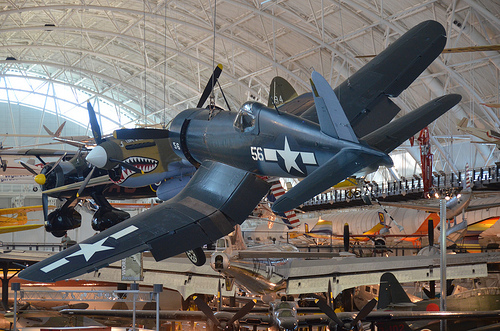
Image by Chris Devers
Quoting Smithsonian National Air and Space Museum | Vought F4U-1D Corsair :
By V-J Day, September 2, 1945, Corsair pilots had amassed an 11:1 kill ratio against enemy aircraft. The aircraft’s distinctive inverted gull-wing design allowed ground clearance for the huge, three-bladed Hamilton Standard Hydromatic propeller, which spanned more than 4 meters (13 feet). The Pratt and Whitney R-2800 radial engine and Hydromatic propeller was the largest and one of the most powerful engine-propeller combinations ever flown on a fighter aircraft.
Charles Lindbergh flew bombing missions in a Corsair with Marine Air Group 31 against Japanese strongholds in the Pacific in 1944. This airplane is painted in the colors and markings of the Corsair Sun Setter, a Marine close-support fighter assigned to the USS Essex in July 1944.
Transferred from the United States Navy.
Manufacturer:
Vought Aircraft Company
Date:
1940
Country of Origin:
United States of America
Dimensions:
Overall: 460 x 1020cm, 4037kg, 1250cm (15ft 1 1/8in. x 33ft 5 9/16in., 8900lb., 41ft 1/8in.)
Materials:
All metal with fabric-covered wings behind the main spar.
Physical Description:
R-2800 radial air-cooled engine with 1,850 horsepower, turned a three-blade Hamilton Standard Hydromatic propeller with solid aluminum blades spanning 13 feet 1 inch; wing bent gull-shaped on both sides of the fuselage.
• • • • •
Quoting Smithsonian National Air and Space Museum | Curtiss P-40E Warhawk (Kittyhawk IA):
Whether known as the Warhawk, Tomahawk, or Kittyhawk, the Curtiss P-40 proved to be a successful, versatile fighter during the first half of World War II. The shark-mouthed Tomahawks that Gen. Claire Chennault’s “Flying Tigers” flew in China against the Japanese remain among the most popular airplanes of the war. P-40E pilot Lt. Boyd D. Wagner became the first American ace of World War II when he shot down six Japanese aircraft in the Philippines in mid-December 1941.
Curtiss-Wright built this airplane as Model 87-A3 and delivered it to Canada as a Kittyhawk I in 1941. It served until 1946 in No. 111 Squadron, Royal Canadian Air Force. U.S. Air Force personnel at Andrews Air Force Base restored it in 1975 to represent an aircraft of the 75th Fighter Squadron, 23rd Fighter Group, 14th Air Force.
Donated by the Exchange Club in Memory of Kellis Forbes.
Manufacturer:
Curtiss Aircraft Company
Date:
1939
Country of Origin:
United States of America
Dimensions:
Overall: 330 x 970cm, 2686kg, 1140cm (10ft 9 15/16in. x 31ft 9 7/8in., 5921.6lb., 37ft 4 13/16in.)
Materials:
All-metal, semi-monocoque
Physical Description:
Single engine, single seat, fighter aircraft.
Steven F. Udvar-Hazy Center: Yellow Northrop N1M flying wing airplane, in front of Northrop P-61C Black Widow and tail of the Boeing B-29 Superfortress “Enola Gay”, et al
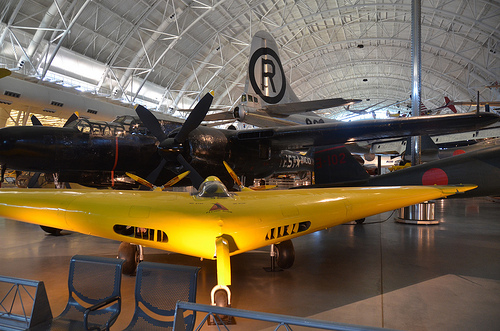
Image by Chris Devers
See more photos of this, and the Wikipedia article.
Details, quoting from Smithsonian National Air and Space Museum: Steven F. Udvar-Hazy | Northrop N1M:
John K. “Jack” Northrop’s dream of a flying wing became a reality on July 3, 1940, when his N-1M (Northrop Model 1 Mockup) first flew. One of the world’s preeminent aircraft designers and creator of the Lockheed Vega and Northrop Alpha, Northrop had experimented with flying wings for over a decade, believing they would have less drag and greater efficiency than conventional designs. His 1929 flying wing, while successful, had twin tail booms and a conventional tail. In the N-1M he created a true flying wing.
Built of plywood around a tubular steel frame, the N-1M was powered by two 65-horsepower Lycoming engines, later replaced with two 120-horsepower Franklins. While its flying characteristics were marginal, the N-1M led to other designs, including the Northrop XB-35 and YB-49 strategic bombers and ultimately the B-2 stealth bomber.
Transferred from the United States Air Force.
Manufacturer:
Northrop Aircraft Inc.
Date:
1940
Country of Origin:
United States of America
Dimensions:
Wingspan: 11.6 m (38 ft)
Length: 5.2 m (17 ft)
Height: 1.5 m (5 ft)
Weight, gross: 1,814 kg (4,000 lb)
Top speed: 322 km/h (200 mph)
Engine: 2 Franklin 6AC264F2, 120 hp
Overall: 72in. (182.9cm)
Other: 72 x 204 x 456in. (182.9 x 518.2 x 1158.2cm)
Materials:
Overall: Plywood
Physical Description:
Twin engine flying wing: Wood, painted yellow.
Long Description:
The N-1M (Northrop Model 1 Mockup) Flying Wing was a natural outgrowth of John K. “Jack” Northrop’s lifelong concern for an aerodynamically clean design in which all unnecessary drag caused by protruding engine nacelles, fuselage, and vertical and horizontal tail surfaces would be eliminated. Developed in 1939 and 1940, the N-1lM was the first pure all-wing airplane to be produced in the United States. Its design was the forerunner of the larger all-wing XB-35 and YB-49 bomber! reconnaissance prototypes that Northrop hoped would win Air Force production contracts and eventually change the shape of modern aircraft.
After serving apprenticeships with the Lockheed brothers and Donald Douglas in the early 1920s and designing the highly successful and innovative Lockheed Vega in 1927, Northrop in the late 192Os turned his attention to all-wing aircraft. In 1928, he left the employ of Lockheed and organized the Avion Corporation; a year later he produced his first flying wing, which incorporated such innovative features as all-metal, multicellular wing and stressed-skin construction. Although the 1929 flying wing was not a true all-wing design because it made use of external control surfaces and outrigger tail booms, it paved the way for the later N-1 M, which proved the basic soundness of Northrop’s idea for an all-wing aircraft. At the time, however, Northrop did not have the money to continue developing the all-wing idea.
In 1939, Northrop formed his own aircraft company, Northrop Aircraft, Inc., and as a result was in a position to finance research and development of the N-1M. For assistance in designing the aircraft, Northrop enlisted the not aerodynamicist Dr. Theodore von Karman, who was at the time Director of the Guggenheim Aeronautical Laboratory at the California Institute Technology, and von Karman’s assistant, Dr. William R. Sears. Walter J. Cerny, Northrop’s assistant design chief, became the overall supervisor for the project. To determine the flight characteristics of an all-wing design, Northrop Cerny conducted extensive wind tunnel tests or flying wing models. Ultimately, the design of the N-1 M benefited from the new low-drag, increase stability NACA airfoils as well as improved flaps spoilers, and other aerodynamic devices.
After a period of a year, the N-1M, nicknamed the “Jeep,” emerged in July 1940 as a boomerang-shaped flying scale mockup built 01 wood and tubular steel with a wingspan of 38 feet a length of 17 feet, and a height of 5 feet. Pitch and roll control was accomplished by means of elevons on the trailing edge of the wing, which served the function of both elevator and aileron the place of the conventional rudder was a split flap device on the wing tips; these were originally drooped downward for what was thought to be better directional stability but later straightened.
Controlled by rudder pedals, the split flaps, or “clamshells,” could be opened to increase the angle of glide or reduce airspeed and thus act as air brakes. The center of gravity, wing sweep, arrangement of control surfaces, and dihedral were adjustable on the ground. To decrease drag, the aircraft’s two 65-hp Lycoming 0-145 four-cylinder engines were buried within the fuselage. These were later discovered to be lacking in sufficient power to sustain lift and were replaced by two 120-hp six-cylinder 6AC264F2 air-cooled Franklin engines.
The N-1M made its first test flight on July 3, 1940, at Baker Dry Lake, California, with Vance Breese at the controls. Breese’s inaugural flight in the N-1 M was inauspicious. During a high-speed taxi run, the aircraft hit a rough spot in the dry lake bed, bounced into the air and accidentally became airborne for a few hundred yards. In the initial stages of flight testing, Breese reported that the aircraft could fly no higher than 5 feet off the ground and that flight could only be sustained by maintaining a precise angle of attack. Von Karman was called in and he solved the problem by making adjustments to the trailing edges of the elevons.
When Vance Breese left the N-1 M program to test-fly the North American B-25, Moye Stephens, the Northrop company secretary, took over testing of the aircraft. By November 1941, after having made some 28 flights, Stephens reported that when attempting to move the N-1M about its vertical axis, the aircraft had a tendency to oscillate in what is called a Dutch roll. That is, the aircraft’s wings alternately rose and fell tracing a circular path in a plane that lies between the horizontal and the vertical. Although Stephens was fearful that the oscillations might not be controllable, he found that adjustments to the aircraft’s configuration cleared up the problem. In May 1942, Stephens was replaced by John Myers, who served as test pilot on the project for approximately six months.
Although the exact period of flight testing for the N-1M is difficult to determine because both Northrop and Army Air Forces records have been lost, we do know that after its initial test flight at Baker Dry Lake, the aircraft was flown at Muroc and Rosamond Dry Lake, and at Hawthorne, California, and that late in the testing program (probably after January 1943) it was towed by a C-47 from Muroc to Hawthorne on its last flight with Myers as the pilot.
From its inception, the N-1M was plagued by poor performance because it was both overweight and chronically underpowered. Despite these problems, Northrop convinced General H. H. Hap” Arnold that the N-1 M was successful enough to serve as the forerunner of more advanced flying wing concepts, and the aircraft did form the basis for Northrop’s subsequent development of the N-M9 and of the larger and longer-ranged XB-35 and YB-49 flying wings.
In 1945, Northrop turned the N-1M over to the Army Air Forces in the hope that it would someday be placed on exhibit. On July 12, 1946, the aircraft was delivered to Freeman Field, Indiana. A little over a month later, the N-1M was given to the National Air Museum and placed in storage at Park Ridge, Illinois. On May 1,1949, the aircraft was placed in the Museum’s collection, and a few years later moved in packing crates to the Museum’s Preservation, Restoration and Storage Facility in Suitland, Maryland. In 1979, the restoration of the N-1M began, and by early 1983, some four decades after it had made its final flight, the aircraft had been returned to its original condition.
• • • • •
Quoting Smithsonian National Air and Space Museum | Northrop P-61C Black Widow:
The P-61 Black Widow was the first U.S. aircraft designed to locate and destroy enemy aircraft at night and in bad weather, a feat made possible by the use of on-board radar. The prototype first flew in 1942. P-61 combat operations began just after D-Day, June 6, 1944, when Black Widows flew deep into German airspace, bombing and strafing trains and road traffic. Operations in the Pacific began at about the same time. By the end of World War II, Black Widows had seen combat in every theater and had destroyed 127 enemy aircraft and 18 German V-1 buzz bombs.
The Museum’s Black Widow, a P-61C-1-NO, was delivered to the Army Air Forces in July 1945. It participated in cold-weather tests, high-altitude drop tests, and in the National Thunderstorm Project, for which the top turret was removed to make room for thunderstorm monitoring equipment.
Transferred from the United States Air Force.
Manufacturer:
Northrop Aircraft Inc.
Date:
1943
Country of Origin:
United States of America
Dimensions:
Overall: 450 x 1500cm, 10637kg, 2000cm (14ft 9 3/16in. x 49ft 2 9/16in., 23450.3lb., 65ft 7 3/8in.)
• • • • •
Quoting Smithsonian National Air and Space Museum | Boeing B-29 Superfortress “Enola Gay”:
Boeing’s B-29 Superfortress was the most sophisticated propeller-driven bomber of World War II and the first bomber to house its crew in pressurized compartments. Although designed to fight in the European theater, the B-29 found its niche on the other side of the globe. In the Pacific, B-29s delivered a variety of aerial weapons: conventional bombs, incendiary bombs, mines, and two nuclear weapons.
On August 6, 1945, this Martin-built B-29-45-MO dropped the first atomic weapon used in combat on Hiroshima, Japan. Three days later, Bockscar (on display at the U.S. Air Force Museum near Dayton, Ohio) dropped a second atomic bomb on Nagasaki, Japan. Enola Gay flew as the advance weather reconnaissance aircraft that day. A third B-29, The Great Artiste, flew as an observation aircraft on both missions.
Transferred from the United States Air Force.
Manufacturer:
Boeing Aircraft Co.
Martin Co., Omaha, Nebr.
Date:
1945
Country of Origin:
United States of America
Dimensions:
Overall: 900 x 3020cm, 32580kg, 4300cm (29ft 6 5/16in. x 99ft 1in., 71825.9lb., 141ft 15/16in.)
Materials:
Polished overall aluminum finish
Physical Description:
Four-engine heavy bomber with semi-monoqoque fuselage and high-aspect ratio wings. Polished aluminum finish overall, standard late-World War II Army Air Forces insignia on wings and aft fuselage and serial number on vertical fin; 509th Composite Group markings painted in black; “Enola Gay” in black, block letters on lower left nose.