CAD/CAM Manufacturers Are Trending Towards Open Architecture: U.S. Market place Led by Sirona, Align Technologies, and EnvisionTec

Vancouver, BC (PRWEB) September 11, 2014

According to a report series by iData Analysis, the leading global authority in health-related device, dental and pharmaceutical industry analysis, the total U.S. CAD/CAM technique market is anticipated to develop to more than $ 300 million by 2020. CAD/CAM systems marketplace involves complete in-lab, standalone scanners and chairside systems. Market place development will be driven by the improve in demand by each customers and dentists for all-ceramic restorations due to their superior aesthetic qualities, biocompatibility of ceramic materials and economical pricing.

&#13

Chairside systems are the fastest expanding market, as much more laboratories and dental offices are going digital, making use of CAD/CAM technologies, intra-oral digital impression-taking devices and rapid prototyping systems. This market place is expected to experience double digit development by 2020. “Chairside use is expected to enhance further due to the new entry of glass ceramics blocks to the marketplace and the reimbursement of resin supplies at the same rate as ceramics,” says Dr. Kamran Zamanian, CEO of iData.

&#13

CAD/CAM makers are trending towards open architecture, meaning that the application can be utilized in conjunction with any milling unit. Open architecture makes it possible for systems presented from various firms to inter-communicate. For example, 3Shape and Dental Wings only offer standalone scanner systems, but they are compatible with various milling systems such as Wieland Dental’s ZENOTEC™ and B&ampD Dental’s ORIGIN® for milling restorations. This trend is far more visible among lower priced CAD/CAM systems such as Schütz Dental’s Tizan™, which gives an open architecture to operate with other systems.

&#13

One particular of the major trends driving the technological developments is the demand for far more assortment offered by CAD/CAM systems, such as versatility in materials utilized allowing for the alternative of utilizing wax or composite material to mill a restoration. An additional driving trend is giving laboratories the alternative of choosing how they want the restoration prepared. DENTSPLY for instance, provides a quantity of techniques to mill a dental restoration making use of their CAD/CAM technologies.

&#13

Essential leading manufacturers in this industry are Sirona, Align Technologies, and EnvisionTec. Other respected competitors such as 3Shape, DENTSPLY, Nobel Biocare and Dental Wings, supply a diverse range of CAD/CAM items and related devices, such as CAD/CAM blocks and prosthetics.

&#13

For far more details&#13

iData’s four-report series on the U.S., European, Asia-Pacific and Emerging “Markets for Dental Prosthetics and CAD/CAM Devices” covers Crowns and Bridges, Inlays and Onlays, Veneers, Dentures, CAD/CAM Systems, Intra-Oral Digital Impression-Taking Systems and Rapid Prototyping Systems.

&#13

The full reports supply a comprehensive analysis like procedure numbers, units sold, marketplace worth, forecasts, as nicely as a detailed competitive marketplace shares and evaluation of main players’ accomplishment techniques in each market and segment.

&#13

For a cost-free executive summary pay a visit to&#13

http://www.idataresearch.com/u-s-dental-prosthetics-cadcam-devices-market place-2014/

&#13

About iData Analysis&#13

iData Study (http://www.idataresearch.com) is an international market research and consulting group focused on supplying industry intelligence for health-related device and pharmaceutical organizations. iData covers analysis in: dental, orthopedics, imaging and more.

&#13
&#13
&#13
&#13
&#13

GN Slurry Separation Plant for Tunnel Boring Machine (TBM)

GN Slurry Separation Plant for Tunnel Boring Machine (TBM)


Houston,Texas (PRWEB) September 12, 2014

GN Solids America concentrate on the liquid and solids separation, recently, GN Solids America developed the new slurry separation plant for TBM drilling mud cleaning. It allows the contractor to get clean water from the TBM slurry for reuse in the TBM project. This saves a lot of income for the waste disposal expense. This plland also can recover drilling fluids for the drilling projects.

&#13

A tunnel boring machine (TBM) also known as a “mole”, is a machine utilised to excavate tunnels with a circular cross section through a range of soil and rock strata. TBM can bore via anything from tough rock to sand. Tunnel diameters can range from a metre (carried out with micro-TBMs) to 19.25 m to date. The TBM business use a similar technology like in the oil gas drilling. TBM utilize the drilling mud for the projects for cooling and sealing the hole. To recycle and reuse the drilling fluids, TBM requirements the slurry separation plant to clean the drilling fluids. Tunnels of significantly less than a meter or so in diameter are generally done using trenchless building methods or horizontal directional drilling rather than TBMs.

&#13

GN Solids Manage developed the TBM slurry separation program for contractors to get clean water for reuse in the TBM project.

&#13

Element 1) Main Slurry Separation Plant

&#13

The primary slurry separation plant is for separation solids upper of 45microns. GN primary slurry separation plant consist of following solids manage equipment.

&#13

1.1)    Double Deck Shale Shaker&#13

Model: GNZS706E-HB &#13

Vibrating mode: Linear Motion&#13

Motor energy: 2×1.94 KW (Italy OLI, 2.5hp)&#13

Vibrating strength: ≤7. G&#13

Deck quantity: two&#13

Screen location: Up deck: two.13 Square Meter, Reduce deck:2.63 Square Meter&#13

Deck angle adjustment: Minus 1 Degree to 5 Degree.&#13

Upper Screen Spec: 3x750x900mm with Opening 2mm&#13

Bottom Screen Spec: 3x700x1250mm with Mesh API 40&#13

Max Treating capacity: 300m³/h&#13

Weight: 1742 kg&#13

Dimension: 2717x2012x1413 mm&#13

Feeding box type: Weir Back sort feeder

&#13

1.2 ) Desander Cleaner &#13

Model: GNZJ703E-3S        &#13

Desander Cones: 10″x3ea        &#13

Max Capacity 360m³/h        &#13

Matching Shaker: GNZS703E        &#13

Vibrating Mode: Linear Motion        &#13

Motor Energy: 2×1.72kW(Italy Oli Brand Motor)        &#13

Vibrating strength: ≤7. G        &#13

Deck angle adjustment: Minus 1 Degree to 5 Degree.        &#13

Screen region: 2.63 Square Meter        &#13

Screen Specifications: three panels (750mm*1250mm API200)        &#13

Starter magnetic force starter        &#13

Weight: 1846Kg        &#13

Dimension: 2419x2113x2147mm        

&#13

Apart from the above two key solids handle equipment, there are mud tanks, centrifugal pumps, &#13

mud agitator as nicely a mud tank attachments for the primary slurry separation method.

&#13

Approach for the Major Slurry separation technique is as below:&#13

The dirty slurry comes from the TBM and feeds to the GNZS706E-HB shale shaker leading layer screen for separation of solids larger than 2mm, and the fluids go by way of the top layer screen to the bottom layer screen to separate solids of 400 Microns.

&#13

Later on, a centrifugal pump takes fluid from the mud tank very first compartment to feed to the 3x10inch desander cones on the GNZJ703E-3S shale shaker. This is the third phase separation for solids larger than 45 microns.

&#13

Soon after the desander, the fluids will go to the second compartment of the mud tank.

&#13

Component two) Slurry Dewatering Centrifuge Separation.

&#13

The slurry dewatering centrifuge separation unit is a 40 FT containerized system for separation fine solids from the drilling fluids. It consists of following primary gear and device.

&#13

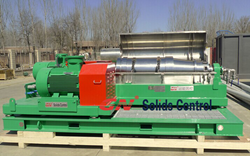
2.1) Big Bowl Big Volume Decanter Centrifuge

&#13

Model: GNLW553-VFD&#13

Bowl Diameter    550mm(22inch)&#13

Bowl Length 1800mm(71inch)&#13

Max. Capacity    484GPM(110m3/h)&#13

Typical Capacity 400GPM(90m3/h)&#13

Max Bowl Speed 3000RPM&#13

Common Bowl Speed    0~2500RPM&#13

G-Force 1888 @ 2500RPM&#13

Separation point two~5μm&#13

Main Motor 90KW(50HP)&#13

Back Motor 37KW(15HP)&#13

Recommended pump 30 HP&#13

Material: Duplex SS2205 for Bowl and SS316L for Screw Propeller&#13

Screw Protection: Tungsten Alloy Tile Protection&#13

Solids Discharge Port: Interchangeable Tunsten carbide alloy&#13

Handle Panel: Stainless Steel with ABB VFD

&#13

The decanter centrifuge has the PLC Control Technique with Touch Screen to manage bowl speed, differential speed, feeding pump speed and flow. Much more more than, the VFD is accessible for handle flucculent pump speed and flow. Password is essential to operate the touch screen. And locking system is offered for operation the touch screen with keys. Flow meters of centrifuge feeding line and flocculent feeding line will send signal to the PLC handle method to avoid the pump from dry suction.

&#13

two.2) Double Chamber Flocculation Unit&#13

Model: LR-6000P&#13

Effective Volume: 6000L in two Chamber&#13

Max dry powder 20 Kg/Hr&#13

Feeding by adjustable speed screw conveyor&#13

Material PP&#13

Funnel volume: 30 L&#13

Dimension: 4000 mm X 1500 mm X 1200 mm&#13

If Grow time 30min, for .three% polymer, mixing capacity 6000l/hr &#13

Energy: 5.0kw, two chamber, with low speed agitator&#13

PLC handle panel, automatic and manually controls feeding screw pump, water pump, motor valves

&#13

The approach of the Slurry Dewatering Centrifuge Separation is as below:&#13

The Double Chamber Flocculation Unit will mix chemicals for the flocculation of the drilling mud took from the second compartment . And later on, the slurry and the polymer will be mixed and feed to the large bowl large volume decanter centrifuge.

&#13

The VFD decanter centrifuge have G force up to 2000 G, this G force is able to separate the fine solids in the drilling mud and discharge clean water for reuse in the TBM project.

&#13

GN Slurry separation plant is widely utilized in the TBM, and horizontal directional drilling and (HDD) mud recycling.

&#13

Get in touch with GN Solids America&#13

Tel:+17138780880&#13

Net: http://www.gnsoldisamerica.com&#13

Add:6710 Windfern Road, Houston, TX 77040,USA

&#13
&#13
&#13
&#13
&#13

DeWys Manufacturing Hires Curtis Kolarik as New Manufacturing Engineer

Marne, MI (PRWEB) September 11, 2014

DeWys Manufacturing Inc. a West-Michigan primarily based metal options company, is pleased to announce the addition of Curtis Kolarik as our new Manufacturing Engineer. In his new part, Curtis will be working to enhance operations and efficiencies within the business. His first project is to implement a big weldment location. This will increase throughput of bulky weldments by utilizing a three axis welding positioner to lower welding time.

&#13

Prior to joining DeWys Manufacturing, Curtis attended Northwestern Michigan College, where he got his Associates of Applied Science. He then transferred to Grand Valley State University for a Bachelor’s degree in Engineering with a main in Solution Design and Manufacturing. Even though attending college he was an intern at DeWys Mfg. for his last three semesters, and employed DeWys for his senior project. Alongside a couple of classmates, they created a two axis positioner which will permit one set up to complete a component as an alternative of several set ups. This will cut down the time per element by 40 seconds with an estimated 35% price savings. The understanding Curtis gained from NMC and GVSU will make him a fantastic asset to DeWys Manufacturing.

&#13

About DeWys

&#13

DeWys (pronounced De-Wise) Manufacturing supplies precision metal fabrication to a variety of clientele from workplace furniture to commercial components. From its manufacturing facility in West Michigan, the organization supplies a wide range of metal production and assembly capabilities to far more than 160 clients in Michigan, Indiana, Wisconsin, Ohio, and numerous other areas of the United States.

&#13

For added data, pay a visit to dewysmfg.com or make contact with DeWys Mfg. at (616) 677-5281

&#13
&#13
&#13
&#13
&#13

Associated Precision Component Manufacturers Press Releases

Steven F. Udvar-Hazy Center: SR-71 Blackbird (tail view)

Steven F. Udvar-Hazy Center: SR-71 Blackbird (tail view)

Check out these aluminium machining china photos:

Steven F. Udvar-Hazy Center: SR-71 Blackbird (tail view)
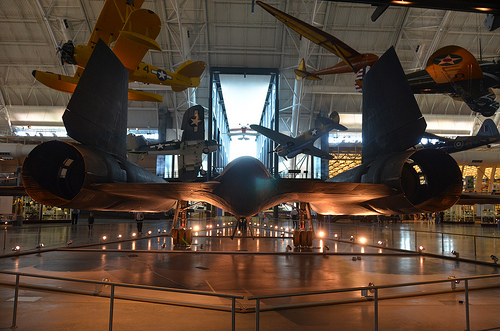
Image by Chris Devers
See more pictures of this, and the Wikipedia report.

Particulars, quoting from Smithsonian National Air and Space Museum | Lockheed SR-71 Blackbird:

No reconnaissance aircraft in history has operated globally in a lot more hostile airspace or with such complete impunity than the SR-71, the world’s quickest jet-propelled aircraft. The Blackbird’s overall performance and operational achievements placed it at the pinnacle of aviation technology developments throughout the Cold War.

This Blackbird accrued about two,800 hours of flight time for the duration of 24 years of active service with the U.S. Air Force. On its last flight, March six, 1990, Lt. Col. Ed Yielding and Lt. Col. Joseph Vida set a speed record by flying from Los Angeles to Washington, D.C., in 1 hour, 4 minutes, and 20 seconds, averaging three,418 kilometers (2,124 miles) per hour. At the flight’s conclusion, they landed at Washington-Dulles International Airport and turned the airplane more than to the Smithsonian.

Transferred from the United States Air Force.

Manufacturer:
Lockheed Aircraft Corporation

Designer:
Clarence L. &quotKelly&quot Johnson

Date:
1964

Country of Origin:
United States of America

Dimensions:
All round: 18ft five 15/16in. x 55ft 7in. x 107ft 5in., 169998.5lb. (5.638m x 16.942m x 32.741m, 77110.8kg)
Other: 18ft five 15/16in. x 107ft 5in. x 55ft 7in. (5.638m x 32.741m x 16.942m)

Materials:
Titanium

Physical Description:
Twin-engine, two-seat, supersonic strategic reconnaissance aircraft airframe constructed largley of titanium and its alloys vertical tail fins are constructed of a composite (laminated plastic-kind material) to minimize radar cross-section Pratt and Whitney J58 (JT11D-20B) turbojet engines feature massive inlet shock cones.

Long Description:
No reconnaissance aircraft in history has operated in far more hostile airspace or with such total impunity than the SR-71 Blackbird. It is the fastest aircraft propelled by air-breathing engines. The Blackbird’s performance and operational achievements placed it at the pinnacle of aviation technology developments throughout the Cold War. The airplane was conceived when tensions with communist Eastern Europe reached levels approaching a complete-blown crisis in the mid-1950s. U.S. military commanders desperately necessary precise assessments of Soviet worldwide military deployments, specifically near the Iron Curtain. Lockheed Aircraft Corporation’s subsonic U-two (see NASM collection) reconnaissance aircraft was an in a position platform but the U. S. Air Force recognized that this relatively slow aircraft was already vulnerable to Soviet interceptors. They also understood that the speedy development of surface-to-air missile systems could place U-2 pilots at grave danger. The danger proved reality when a U-two was shot down by a surface to air missile more than the Soviet Union in 1960.

Lockheed’s 1st proposal for a new higher speed, high altitude, reconnaissance aircraft, to be capable of avoiding interceptors and missiles, centered on a style propelled by liquid hydrogen. This proved to be impracticable since of considerable fuel consumption. Lockheed then reconfigured the style for traditional fuels. This was feasible and the Central Intelligence Agency (CIA), already flying the Lockheed U-2, issued a production contract for an aircraft designated the A-12. Lockheed’s clandestine ‘Skunk Works’ division (headed by the gifted style engineer Clarence L. &quotKelly&quot Johnson) developed the A-12 to cruise at Mach 3.2 and fly properly above 18,288 m (60,000 feet). To meet these difficult specifications, Lockheed engineers overcame many daunting technical challenges. Flying more than 3 times the speed of sound generates 316° C (600° F) temperatures on external aircraft surfaces, which are enough to melt traditional aluminum airframes. The design group chose to make the jet’s external skin of titanium alloy to which shielded the internal aluminum airframe. Two conventional, but really effective, afterburning turbine engines propelled this exceptional aircraft. These power plants had to operate across a massive speed envelope in flight, from a takeoff speed of 334 kph (207 mph) to a lot more than three,540 kph (two,200 mph). To avert supersonic shock waves from moving inside the engine intake causing flameouts, Johnson’s group had to design a complicated air intake and bypass method for the engines.

Skunk Performs engineers also optimized the A-12 cross-section style to exhibit a low radar profile. Lockheed hoped to accomplish this by very carefully shaping the airframe to reflect as small transmitted radar power (radio waves) as achievable, and by application of special paint created to absorb, rather than reflect, those waves. This therapy became a single of the very first applications of stealth technologies, but it in no way entirely met the design and style targets.

Test pilot Lou Schalk flew the single-seat A-12 on April 24, 1962, right after he became airborne accidentally for the duration of high-speed taxi trials. The airplane showed wonderful guarantee but it required considerable technical refinement just before the CIA could fly the initial operational sortie on Could 31, 1967 – a surveillance flight over North Vietnam. A-12s, flown by CIA pilots, operated as element of the Air Force’s 1129th Unique Activities Squadron under the &quotOxcart&quot program. Although Lockheed continued to refine the A-12, the U. S. Air Force ordered an interceptor version of the aircraft designated the YF-12A. The Skunk Operates, nonetheless, proposed a &quotspecific mission&quot version configured to conduct post-nuclear strike reconnaissance. This system evolved into the USAF’s familiar SR-71.

Lockheed constructed fifteen A-12s, including a particular two-seat trainer version. Two A-12s have been modified to carry a specific reconnaissance drone, designated D-21. The modified A-12s had been redesignated M-21s. These had been designed to take off with the D-21 drone, powered by a Marquart ramjet engine mounted on a pylon among the rudders. The M-21 then hauled the drone aloft and launched it at speeds higher adequate to ignite the drone’s ramjet motor. Lockheed also constructed three YF-12As but this type in no way went into production. Two of the YF-12As crashed in the course of testing. Only one particular survives and is on display at the USAF Museum in Dayton, Ohio. The aft section of a single of the &quotwritten off&quot YF-12As which was later employed along with an SR-71A static test airframe to manufacture the sole SR-71C trainer. One SR-71 was lent to NASA and designated YF-12C. Including the SR-71C and two SR-71B pilot trainers, Lockheed constructed thirty-two Blackbirds. The 1st SR-71 flew on December 22, 1964. Simply because of intense operational charges, military strategists decided that the a lot more capable USAF SR-71s should replace the CIA’s A-12s. These were retired in 1968 after only 1 year of operational missions, largely more than southeast Asia. The Air Force’s 1st Strategic Reconnaissance Squadron (portion of the 9th Strategic Reconnaissance Wing) took over the missions, flying the SR-71 starting in the spring of 1968.

Soon after the Air Force began to operate the SR-71, it acquired the official name Blackbird– for the special black paint that covered the airplane. This paint was formulated to absorb radar signals, to radiate some of the tremendous airframe heat generated by air friction, and to camouflage the aircraft against the dark sky at higher altitudes.

Expertise gained from the A-12 system convinced the Air Force that flying the SR-71 safely essential two crew members, a pilot and a Reconnaissance Systems Officer (RSO). The RSO operated with the wide array of monitoring and defensive systems installed on the airplane. This gear incorporated a sophisticated Electronic Counter Measures (ECM) technique that could jam most acquisition and targeting radar. In addition to an array of advanced, higher-resolution cameras, the aircraft could also carry equipment made to record the strength, frequency, and wavelength of signals emitted by communications and sensor devices such as radar. The SR-71 was developed to fly deep into hostile territory, avoiding interception with its tremendous speed and higher altitude. It could operate safely at a maximum speed of Mach three.three at an altitude much more than sixteen miles, or 25,908 m (85,000 ft), above the earth. The crew had to put on pressure suits similar to these worn by astronauts. These suits have been needed to shield the crew in the occasion of sudden cabin stress loss although at operating altitudes.

To climb and cruise at supersonic speeds, the Blackbird’s Pratt &amp Whitney J-58 engines were developed to operate continuously in afterburner. Whilst this would seem to dictate high fuel flows, the Blackbird in fact achieved its ideal &quotgas mileage,&quot in terms of air nautical miles per pound of fuel burned, throughout the Mach three+ cruise. A typical Blackbird reconnaissance flight might require numerous aerial refueling operations from an airborne tanker. Every time the SR-71 refueled, the crew had to descend to the tanker’s altitude, typically about six,000 m to 9,000 m (20,000 to 30,000 ft), and slow the airplane to subsonic speeds. As velocity decreased, so did frictional heat. This cooling effect caused the aircraft’s skin panels to shrink significantly, and those covering the fuel tanks contracted so significantly that fuel leaked, forming a distinctive vapor trail as the tanker topped off the Blackbird. As quickly as the tanks had been filled, the jet’s crew disconnected from the tanker, relit the afterburners, and once again climbed to higher altitude.

Air Force pilots flew the SR-71 from Kadena AB, Japan, all through its operational career but other bases hosted Blackbird operations, also. The 9th SRW occasionally deployed from Beale AFB, California, to other areas to carryout operational missions. Cuban missions were flown directly from Beale. The SR-71 did not begin to operate in Europe till 1974, and then only temporarily. In 1982, when the U.S. Air Force based two aircraft at Royal Air Force Base Mildenhall to fly monitoring mission in Eastern Europe.

When the SR-71 became operational, orbiting reconnaissance satellites had already replaced manned aircraft to collect intelligence from websites deep inside Soviet territory. Satellites could not cover every single geopolitical hotspot so the Blackbird remained a vital tool for global intelligence gathering. On several occasions, pilots and RSOs flying the SR-71 offered data that proved important in formulating productive U. S. foreign policy. Blackbird crews supplied essential intelligence about the 1973 Yom Kippur War, the Israeli invasion of Lebanon and its aftermath, and pre- and post-strike imagery of the 1986 raid conducted by American air forces on Libya. In 1987, Kadena-primarily based SR-71 crews flew a number of missions more than the Persian Gulf, revealing Iranian Silkworm missile batteries that threatened commercial shipping and American escort vessels.

As the overall performance of space-primarily based surveillance systems grew, along with the effectiveness of ground-primarily based air defense networks, the Air Force began to shed enthusiasm for the expensive system and the 9th SRW ceased SR-71 operations in January 1990. Despite protests by military leaders, Congress revived the system in 1995. Continued wrangling over operating budgets, however, quickly led to final termination. The National Aeronautics and Space Administration retained two SR-71As and the 1 SR-71B for high-speed investigation projects and flew these airplanes until 1999.

On March six, 1990, the service profession of one particular Lockheed SR-71A Blackbird ended with a record-setting flight. This specific airplane bore Air Force serial quantity 64-17972. Lt. Col. Ed Yeilding and his RSO, Lieutenant Colonel Joseph Vida, flew this aircraft from Los Angeles to Washington D.C. in 1 hour, 4 minutes, and 20 seconds, averaging a speed of 3,418 kph (2,124 mph). At the conclusion of the flight, ‘972 landed at Dulles International Airport and taxied into the custody of the Smithsonian’s National Air and Space Museum. At that time, Lt. Col. Vida had logged 1,392.7 hours of flight time in Blackbirds, a lot more than that of any other crewman.

This specific SR-71 was also flown by Tom Alison, a former National Air and Space Museum’s Chief of Collections Management. Flying with Detachment 1 at Kadena Air Force Base, Okinawa, Alison logged more than a dozen ‘972 operational sorties. The aircraft spent twenty-4 years in active Air Force service and accrued a total of 2,801.1 hours of flight time.

Wingspan: 55’7&quot
Length: 107’5&quot
Height: 18’6&quot
Weight: 170,000 Lbs

Reference and Further Reading:

Crickmore, Paul F. Lockheed SR-71: The Secret Missions Exposed. Oxford: Osprey Publishing, 1996.

Francillon, Rene J. Lockheed Aircraft Because 1913. Annapolis, Md.: Naval Institute Press, 1987.

Johnson, Clarence L. Kelly: Far more Than My Share of It All. Washington D.C.: Smithsonian Institution Press, 1985.

Miller, Jay. Lockheed Martin’s Skunk Works. Leicester, U.K.: Midland Counties Publishing Ltd., 1995.

Lockheed SR-71 Blackbird curatorial file, Aeronautics Division, National Air and Space Museum.

DAD, 11-11-01
Microscan Launches Verification Monitoring Interface (VMI) to Grade Barcodes and Monitor Trends in Quality in Genuine Time

Microscan Launches Verification Monitoring Interface (VMI) to Grade Barcodes and Monitor Trends in Quality in Genuine Time


Renton, WA (PRWEB) September 11, 2014

Microscan, a worldwide technology leader in barcode, machine vision, and lighting solutions, announces the availability of the Verification Monitoring Interface (VMI), a new software resolution specially engineered for monitoring the good quality of barcodes as they are created on components, labels, and packaging.

&#13

Unreadable barcodes can lead to pricey scrap, downtime, and errors in the provide chain and at the point of sale. This is why much more and a lot more retailers are issuing mandates to their suppliers concerning minimum barcode good quality, which leaves suppliers facing achievable fines for unreadable codes and disqualification for non-compliance. Microscan has developed effortless-to-use verification solutions to meet the require for inline (directly after merchandise are marked) and offline verification to ISO and AIM barcode high quality standards, even in high-speed applications, to support manufacturers meet client demands and guarantee efficiency throughout the supply chain. These options are tailored to meet ISO and AIM requirements and combine Microscan machine vision technology, like Vision HAWK sensible camera models, NERLITE® industrial lighting, and AutoVISION® Machine Vision Software.

&#13

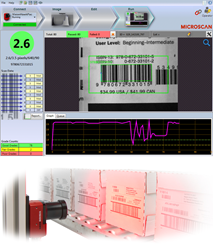
The new VMI software program plug-in provides a custom Runtime window in AutoVISION Machine Vision Computer software for visualizing the final results of ISO barcode good quality verification as nicely as fluctuations in barcode top quality more than time. As VMI operates on the production line, companies can use this reside data about their barcodes to set alarms or trigger actions based on low barcode good quality, which may possibly indicate degradation of the printing or marking method such as jammed print heads, low ink, and more. By implementing barcode verification as a preventative measure, and with VMI operating in real time as items are marked and labeled, poor and unreadable codes are prevented from entering the supply chain. Thanks to the resolution, manufacturers can significantly increase product good quality, operational efficiency, minimize scrap and unplanned downtime, and keep away from costly fines connected with poor or non-compliant barcodes.

&#13

For much more info on Microscan’s new Verification Monitoring Interface (VMI) and AutoVISION Machine Vision Software, visit http://www.microscan.com.

&#13

About Microscan&#13

Microscan is a international leader in technology for precision data acquisition and handle solutions serving a wide range of automation and OEM applications. Founded in 1982, Microscan has a powerful history of technologies innovation that contains the invention of the very first laser diode barcode scanner and the 2D symbology, Information Matrix. Today, Microscan remains a technology leader in automatic identification and machine vision with extensive solutions for ID tracking, traceability and inspection ranging from fundamental barcode reading up to complicated machine vision inspection, identification, and measurement.

&#13

As an ISO 9001:2008 certified organization recognized for high quality leadership in the U.S., Microscan is known and trusted by consumers worldwide as a provider of good quality, higher precision products. Microscan is a Spectris business.

&#13
&#13
&#13
&#13
&#13

Locate More Precision Machined Components Press Releases

Crystallume to Introduce New Merchandise at IMTS 2014

Crystallume to Introduce New Merchandise at IMTS 2014


Santa Clara, CA (PRWEB) September 09, 2014

Crystallume, the business that pioneered the development and application of Chemical Vapor Deposition (CVD) diamond coating technology will showcase its latest innovations at this year’s IMTS 2014, the International Manufacturing Technologies Show. Crystallume dominates the market with more than 25 patents awarded. A sampling of Crystallume’s new items follows.

&#13

This year’s IMTS lineup includes diamond coated coolant hole drills specially created to properly evacuate chips and dust out of a drilled hole in deep-drilling applications, producing cleaner, faster and a lot more productive cuts.

&#13

Kevlar drills, featuring an exclusive Black Widow coating (a combination of diamond and graphite), are designed with points specifically for creating clean holes in Kevlar. The Black Widow coating provides extended life for longer running jobs.

&#13

Curved flute composite routers are created for trimming composite material such as carbon fiber and has a fluted design and style curved like a crescent moon to lessen delamination.

&#13

Rough cut and fine cut alligator back routers are created to function exceptionally in composite trimming applications. The alligator back style increases feed rate even though preserving low tear-out. Rough and fine cuts provide rapidly trimming.

&#13

Precise-size mold producing end mills are for ultra-precision five-axis electrode jobs where the precise size of the end mill is needed. Precise-sizing is now furnished at no additional cost on the Mold Maker end mill series.

&#13

“We’re excited to be releasing such a potent line of tools—all of which were designed to exceed buyer demands.” mentioned Ed Francis, VP of Engineering at Crystallume. “Visitors to our IMTS booth will see some of the most innovative solutions for composite machining becoming introduced at IMTS. Crystallume is consistently pushing the envelope of tool design and style, from the Bullet drills introduced at the final IMTS to these new solutions presented this year.”

&#13

Far more info about Crystallume, which includes the total Crystallume solution line can be identified at http://www.crystallume.com. Visit Crystallume at this year’s IMTS show in booth W-2206.

&#13

###

&#13

About Crystallume&#13

Founded in 1984, Crystallume pioneered the development and application of Chemical Vapor Deposition (CVD) diamond technology. Because then, Crystallume’s coating professionals have turn out to be specialists at solving buyer difficulties with diamond technology at the largest CVD Diamond facility in the United Sates. For more details, visit http://www.crystallume.com, or to schedule a meeting, contact Manny Guevara at mguevara@crystallume.com.

&#13
&#13
&#13
&#13
&#13

Connected Milling Machine Press Releases

Cool Turned Components images

Cool Turned Components images

Some cool turned elements photos:

Operate Bench

Image by KLaFaille
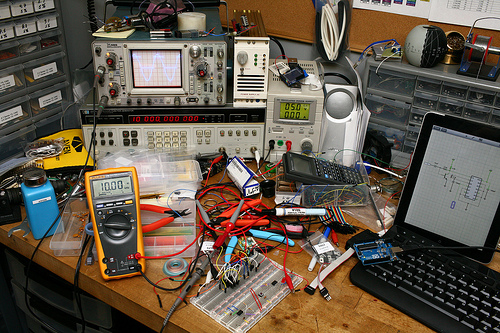
Breadboarding a low pass filter making use of two triggers in a SN74HC14 to turn a low level, sine wave into 5V logic input.

On the scope is the 30mV 10kHz sine wave from the HP function generator overlaid on the 5V logic from the 74HC14. Purpose is to input this into a uC as a poor man’s frequency counter. Circuit design and style credit goes to PJRC.

Note all the crap on the bench, but the distinct lack of proper BNC cables for the HP. A single of these days..

How a ball personal computer mouse functions

Image by explainthatstuff
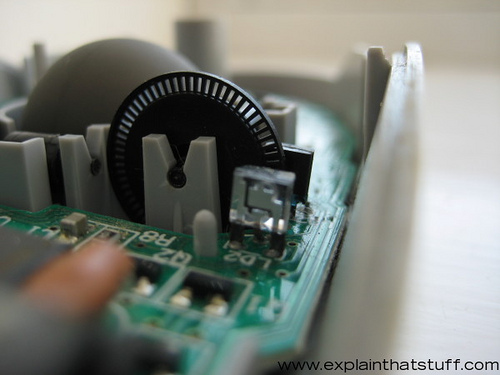
Here’s a closeup of the mechanism that makes it possible for an old-style ball mouse to detect your hand movements. There’s a light beam operating among the transparent square (an LED-style light emitter) and the black square (a photocell/light detector). As you move your hand, the mouse ball moves too. It pushes against a roller that turns the spoked wheel, breaking the light beam repeatedly. Counting the quantity of occasions the beam is broken provides a precise measurement of how far your hand has moved.

This photo is from our report on how computer mice function.

For a bit more context, see the photo of the exact same mouse taken from overhead.

Our images are published below a Inventive Commons Licence (see opposite) and are cost-free for noncommercial use. We also license our images for commercial use. Please speak to us directly by way of our web site for far more specifics.