A couple of good precision engineering services pictures I located:
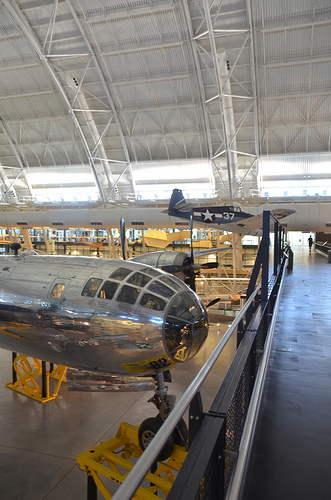
Steven F. Udvar-Hazy Center: south hangar panorama, like B-29 Superfortress “Enola Gay”, Grumman F6F-3 Hellcat, among others
Image by Chris Devers
See much more photos of this, and the Wikipedia write-up.
Details, quoting from Smithsonian National Air and Space Museum: Steven F. Udvar-Hazy | Boeing B-29 Superfortress "Enola Gay":
Boeing’s B-29 Superfortress was the most sophisticated propeller-driven bomber of Globe War II and the very first bomber to residence its crew in pressurized compartments. Although developed to fight in the European theater, the B-29 discovered its niche on the other side of the globe. In the Pacific, B-29s delivered a selection of aerial weapons: conventional bombs, incendiary bombs, mines, and two nuclear weapons.
On August six, 1945, this Martin-constructed B-29-45-MO dropped the very first atomic weapon used in combat on Hiroshima, Japan. 3 days later, Bockscar (on show at the U.S. Air Force Museum near Dayton, Ohio) dropped a second atomic bomb on Nagasaki, Japan. Enola Gay flew as the advance weather reconnaissance aircraft that day. A third B-29, The Fantastic Artiste, flew as an observation aircraft on each missions.
Transferred from the United States Air Force.
Manufacturer:
Boeing Aircraft Co.
Martin Co., Omaha, Nebr.
Date:
1945
Country of Origin:
United States of America
Dimensions:
General: 900 x 3020cm, 32580kg, 4300cm (29ft 6 five/16in. x 99ft 1in., 71825.9lb., 141ft 15/16in.)
Components:
Polished all round aluminum finish
Physical Description:
4-engine heavy bomber with semi-monoqoque fuselage and high-aspect ratio wings. Polished aluminum finish overall, common late-World War II Army Air Forces insignia on wings and aft fuselage and serial number on vertical fin 509th Composite Group markings painted in black "Enola Gay" in black, block letters on lower left nose.
• • • • •
See more pictures of this, and the Wikipedia post.
Information, quoting from Smithsonian National Air and Space Museum: Steven F. Udvar-Hazy | Grumman F6F-3 Hellcat:
The Grumman F6F Hellcat was initially conceived as an advanced version of the U.S. Navy’s then existing front-line fighter, the F4F Wildcat (see NASM collection). The Wildcat’s intended replacement, the Vought F4U Corsair (see NASM collection), initial flown in 1940, was displaying great promise, but improvement was slowed by troubles, such as the crash of the prototype.
The National Air and Space Museum’s F6F-3 Hellcat, BuNo. 41834, was built at Grumman’s Bethpage, New York, factory in February 1944 under contract NOA-(S)846. It was delivered to the Navy on February 7, and arrived in San Diego, California, on the 18th. It was assigned to Fighter Squadron 15 (VF-15) on USS Hornet (CV12) bound for Hawaii. On arrival, it was assigned to VF-3 exactly where it sustained harm in a wheels-up landing at NAS Barbers Point, Hawaii. After repair, it was assigned to VF-83 where it was utilized in a coaching role until February 21, 1945. Right after several transfers 41834 was converted to an F6F-3K target drone with the installation of sophisticated radio-control gear. It was painted red with a pink tail that carried the number 14. Its mission was to be used in Operation Crossroads – the atomic bomb tests at Bikini Atoll. It flew on June 24, 1946, with a pilot, on a practice flight and was launched, unmanned, soon following the first bomb test. Instrumentation on board and photographic plates taped to the handle stick obtained information on radioactivity. 3 more manned flights preceded the final unmanned flight on July 25, 1946, which evaluated the 1st underwater explosion. Records indicate that exposure of this aircraft to the radioactive cloud was minimal and residual radiation is negligible.
F6F-3K 41834 was transferred to NAS Norfolk and logged its final flight on March 25, 1947, with a total of 430.two flying hours. It was assigned to the National Air Museum on November 3, 1948, and remained at Norfolk till October four, 1960, when it was moved by barge to Washington and placed in storage. In 1976 this Hellcat was loaned to the USS Yorktown Museum at Charleston, South Carolina. A superficial restoration was performed at the museum, but because of the harsh environment and its poor condition the Hellcat was returned to NASM on March 16, 1982. In 1983, it was sent to Grumman Aerospace where a team of volunteers entirely restored the aircraft. In 1985, it was shipped back to the Paul E. Garber Preservation, Restoration and Storage Facility in Suitland, Maryland, and place in storage. NASM’s F6F-three Hellcat is scheduled to be displayed in the new Steven F. Udvar-Hazy center at Dulles International Airport in Virginia in 2004.
Transferred from the United States Navy.
Manufacturer:
Grumman Aircraft Engineering Corporation
Date:
1943
Country of Origin:
United States of America
Dimensions:
General: 338 x 1021cm, 4092kg, 1304cm (11ft 1 1/16in. x 33ft 5 15/16in., 9021.2lb., 42ft 9 3/8in.)
Physical Description:
Heavy armor plate, reinforced empennage, R-2800-10W engine, spring tabs on the ailerons (improved maneuverability), could carry rockets as effectively as bombs.